A homegrown Nebraskan and first-generation college student, Allison Porter Carpenter didn’t know what her college experience would look like — but she found her path at the University of Nebraska–Lincoln.
From exploring space and life sciences as an undergraduate to completing a master’s at MIT and a doctorate at Harvard-MIT Health Sciences and Technology, Carpenter’s journey led her to an extraordinary role at NASA.
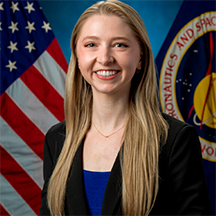
Today, she works with the Lunar Architecture Team and contributes to crew systems integration for the Orion spacecraft. The work supports preparations for Artemis II, the NASA’s first crewed lunar flight in more than 50 years. Carpenter helps verify that Orion’s systems meet human-system requirements and participates in human-in-the-loop testing, shaping how astronauts will live and work on future lunar missions.
Artemis II is currently targeted to launch from Kennedy Space Center at 5:24 p.m. April 1, with additional backup opportunities through April 6. The mission will send four astronauts on a roughly 10-day journey around the Moon and back, testing spacecraft systems and deep-space operations in preparation for future lunar landings.
Read on to hear Carpenter reflect on her time at Nebraska, the mentors who guided her, and the experiences that launched her into a career at the forefront of space exploration.
Why did you decide to apply and attend Nebraska and what led you to biological systems engineering?
Growing up in a very small town, I thought I wanted to go out of state for college. But after receiving the Regents Scholarship, my parents and I visited campus, and I was immediately impressed by the range of opportunities — from STEM majors to extracurriculars. I realized I didn’t have to leave the state to find new experiences, and for the first time, I could really see myself at UNL. Once I visited, it just felt right.
In high school, I was interested in both space and life sciences. I loved physics and even took an astronomy course through UNL, but I was also drawn to biology and medicine. I entered college planning to pursue physics, but it didn’t feel like the right fit. When I found biological systems engineering, especially with the biomedical engineering minor, it felt like the perfect way to combine my interests. Later, learning how biomedical engineering applies to human spaceflight confirmed I had found the right path.
As a first-generation college student, what challenges did you face and how did you overcome them?
My biggest challenge was not having a strong familiarity with academia, which made the transition overwhelming. I had always been very focused on grades, so the shift to college caught me off guard. While my parents were incredibly supportive, this was outside their experience.
I overcame that by leaning on academic advisers and professors. Spending time in their offices helped me build a support system and better understand how to navigate college — and later, how to pursue graduate school.
Tell us about your NASA internships and how they shaped your career.
At Nebraska, I conducted undergraduate research in the BIBA Lab, using ultrasound to study blood flow in the brain. That experience led to my first NASA internship at Johnson Space Center, where I worked on a project studying Spaceflight Associated Neuro-Ocular Syndrome (SANS), a condition that affects astronauts’ vision.
The following summer at Glenn Research Center, I approached SANS from a computational modeling perspective. I later returned to Johnson Space Center for multiple internships focused on human performance and exercise. My final internship involved supporting SEATEST 6.
Each internship built on the last, helping me develop new skills, understand NASA culture and refine what I wanted in my career. They also helped guide my education and ultimately led to my current role.
What does your current role at NASA involve?
I work on the Lunar Architecture Team, which helps define mission concepts and system designs for upcoming Artemis missions. My focus has been on human-in-the-loop testing, where we simulate mission scenarios with human participants to gather data that informs future missions.
One of my favorite projects was SEATEST 7, which evaluated strategies for transporting equipment to a lunar habitat. I’ve also been working on crew systems integration for the Orion spacecraft, ensuring it meets human system requirements for Artemis II.
What was your experience like working in Italy during your master’s research?
It was incredible. With little notice, I packed two suitcases and moved to Vicenza for the summer to work with a small startup. I got to know the team closely, learned about their culture and explored a new city every weekend.
It was also a very productive time — I learned a lot about wearable airbag technology and developed the first prototype of my soft knee exoskeleton.
What excites you about your future with NASA?
It’s an exciting time at NASA, especially with Artemis II and III on the horizon. I’ve had the chance to contribute to these missions through my work in crew systems integration, and I’m especially excited to (hopefully) see a launch in person.
Long term, I want to continue gaining experience in human-in-the-loop testing and crew integration to better understand how to design systems that support crew performance and safety.
Was there someone at Nebraska who had a lasting impact on you?
Dr. Greg Bashford had a huge impact on me. When I was considering biological systems engineering, he took the time to explain the field, introduce me to research and help me get involved in the BIBA Lab. He also mentored me through the UCARE program.
His passion for biomedical engineering was contagious, and my work in his lab directly led to my first NASA internship. That experience solidified my interest in human spaceflight and helped shape my career.
What advice would you give to Nebraska students?
Don’t be the thing that holds you back. Apply for opportunities that feel out of reach and take chances even when you’re not 100% confident. To live is to learn — and we’re all figuring it out together.