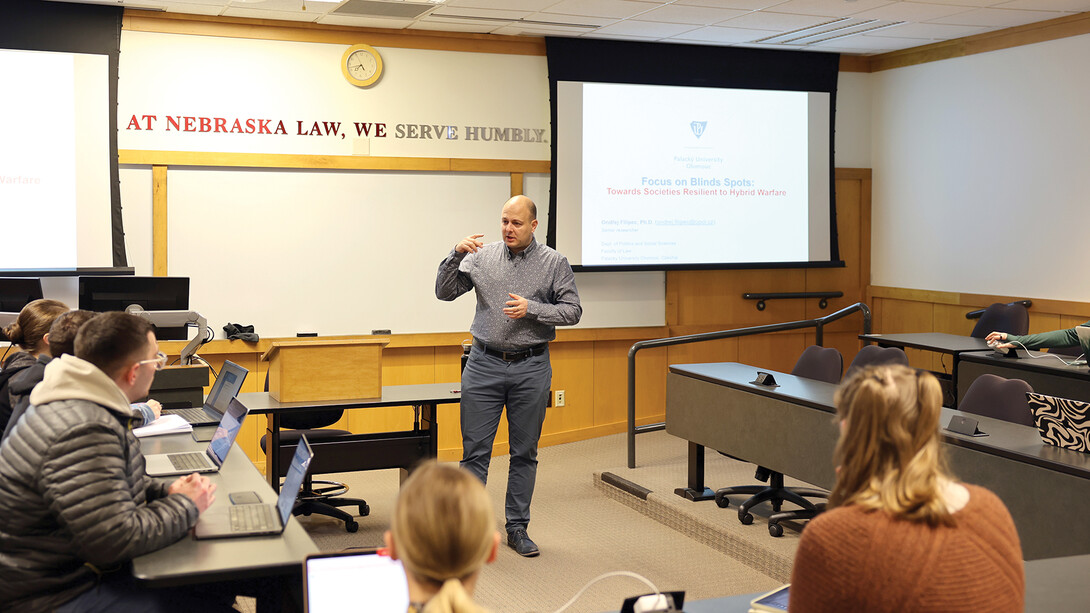
A faculty exchange and study abroad program with a Czech university connects Nebraska Law students with a global perspective on legal systems, most recently with a visit from Ondrej Filipec, a professor from Palacký University.
Danielle Jefferis, associate professor of law and Schmid Professor for Excellence in Research, said the examination of other systems helps students gain insight into alternative methods of helping clients.
“If one of our students, after they graduate, sees a problem the legal system is not solving, and they have this broader perspective, they might be able to draw on creative solutions to solve that problem for their client,” Jefferis said.
The partnership between the College of Law and Palacký University, in Olumouc, Czechia, includes programs for both undergraduate and law students. This year will be the first year for undergraduates and second for law students. Faculty from each university teach a two- or three-week class at the partner institution. Students from both universities also take courses at the partner school.
Jefferis, a faculty participant in the program who visited Palacký last year and taught a course on comparative legal systems, said the exchange helps students discover a wider range of solutions to questions they might encounter in their careers. They can be inspired by how other systems address those problems.
“It exposes them to different approaches and different systems,” she said. “Seeing how things are done differently can help them look inward and think, ‘Can we learn from that other system? Are there elements that are working well we might be able to adopt for our own?’ I think that speaks to a more sophisticated way of thinking about systems and perhaps greater creativity in problem solving.”
Filipec was in Lincoln for two weeks and taught a course on democratic resilience. Filipec said democracies around the world are challenged by issues like misinformation and propaganda, but people can lessen polarization through shared values of democracy.
“Every democracy is facing challenges” he said. “I’m trying to put all of these challenges in a broad context and ground it in democratic values, like civic responsibility, rule of law, human rights and freedoms.”
For Filipec, the themes of the course resonate because they are relevant in so many places and at so many levels. Online discourse is contributing to polarization and radicalization, which heightens the risk worldwide for war or smaller conflicts.
“It connects the international level, national level and local level,” he said. “International relations are getting more authoritarian, so there is more space for conflict, for violence.”
Filipec said as students prepare for careers in law or policymaking, this knowledge equips them to better recognize and address issues they might encounter when they enter the professional field.
“These challenges must be somehow met by the new generation,” he said. “We, as teachers and educators, are preparing the new generation, future leaders. We expect that our students will shape the world, so it’s necessary to equip them with complex understanding of the issues and how it is related to these values and daily lives.”
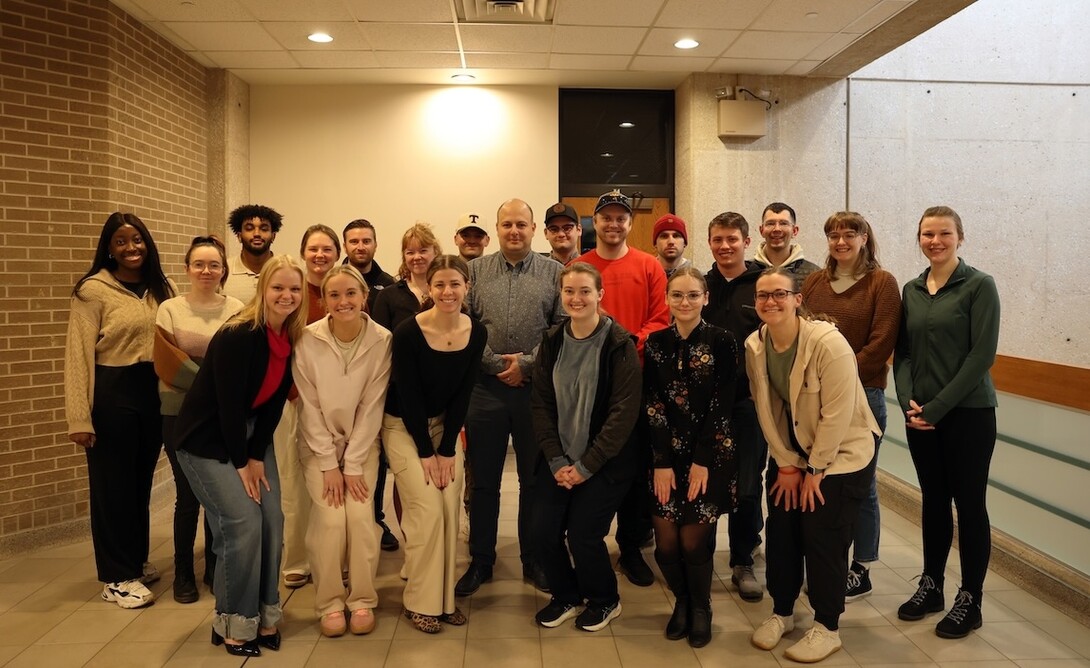
In their courses, each faculty member relies on their area of expertise to determine topics. In addition to comparative legal systems and democratic resilience, topics have included or will include family law and cryptocurrency regulation.
“Each person gets to draw on their own interest and research to create something really specific, but also comparative, picking up on both places,” Jefferis said.
Filipec said he hopes offering an international view of the issues will help students to consider challenges differently and develop new ways of thinking of solutions.
“We are bringing interesting topics, diversity in approaches and attitudes, and this is stimulating students to think more globally or in a slightly different way, and this is necessary for discussion and the exchange of ideas,” he said.
Jefferis said this comparative approach builds skills for the future lawyers to help their clients with any problem, whether the student stays in Nebraska or moves elsewhere.
“Even if our Nebraska Law students wish to stay in Nebraska and practice in our community, having gained that comparative perspective further refines their own understanding of our system and what our system is intended to accomplish and where it does that well and where it might need to be improved,” she said. “Law students tend to learn about American law and think that’s the only way to do things, and this experience shows them that’s not the case and there might be lessons to be learned from other systems, and I think that’s true for the faculty, too.”