A federal grant is helping Nebraska communities reimagine how trees can strengthen infrastructure, aesthetics, local economies and resilience.
PlantNebraska, a statewide nonprofit, is partnering with the University of Nebraska–Lincoln to manage a $10 million grant from the U.S. Forest Service, part of the U.S. Department of Agriculture. The funding is aimed at removing dying and hazardous trees, replacing them at a one-to-one ratio, and supporting workforce development efforts that enhance local expertise in tree care and generate new jobs.
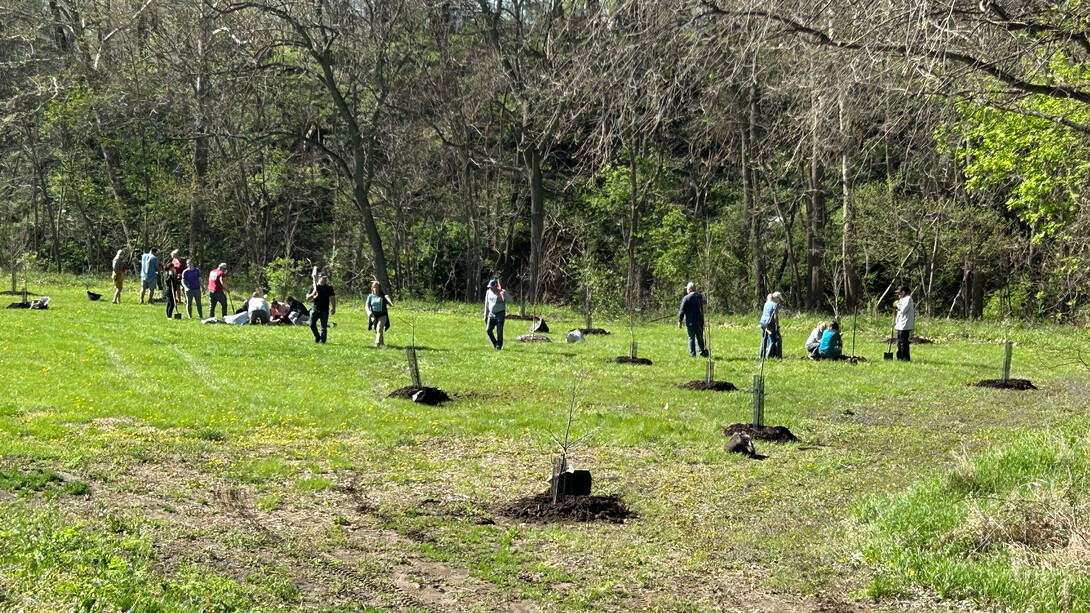
The grant is impacting a wide range of communities across Nebraska, from rural villages like Arnold, to small cities like Gordon and Gothenburg, to metro areas like Lincoln and Omaha. It has touched these populations at every scale, including individual homeowners, schools and community centers, and shared public spaces. As the five-year project nears its halfway point, the university and PlantNebraska have led the way in planting nearly 900 trees, removing more than 600 hazardous ones and providing forestry training to almost 30 people.
“This is the on-the-ground impact of the university,” said Hanna Pinneo, executive director of PlantNebraska. “You can look at every tree planted and see UNL and PlantNebraska at work in your community — shoulder-to-shoulder with the people living there.”
Pinneo said Nebraska communities are experiencing an acute need for tree removal, especially as emerald ash borer continues to devastate many of the state’s 44 million ash trees. This surge in demand for removal has combined with other factors — complex removal logistics, labor and equipment constraints, and shortage of skilled arborists — to drive up costs.
“It doesn’t matter the size of the community — nobody has it in their budget to do all the removals that they need," Pinneo said. "Lincoln and Omaha don’t have it; Beaver Crossing doesn’t have it. That’s just the reality of managing trees."
That means that across the state, hazardous trees threaten valuable infrastructure like homes, buildings, powerlines and sidewalks. The grant has been a mechanism for tackling that problem. In Gordon, a city of about 1,500 people near the state’s northwest border, there was a large, dying tree on a residential property across from a school.
“They were really worried about it falling during school time when students were walking,” Pinneo said. “It was a safety issue, but it was a very difficult removal and the homeowner couldn’t afford it, and neither could the city.”
Through the USDA Forest Service grant, the city accessed $10,000 to remove the tree and replant one that was safe for the space. The funding also enabled the city to plant additional trees on the school property to help with shade and wind protection.
Omaha, too, is plagued by hazardous trees. In many of its city parks, which serve the metro area’s roughly 500,000 residents, there are dead and hazardous trees that threaten visitors’ safety during storms and strong wind. Through the grant, PlantNebraska is facilitating the removal of trees from Dahlman, Hanscom, Kountze, Levi Carter and Benson parks — and then replanting to ensure safety and shade.
Beyond removal, the funding has sparked revitalization and economic development. In Gothenburg, a central Nebraska city with about 3,500 residents, the grant has played a role in the city’s growth plans, a centerpiece of which is the Impact Center. The facility opened in 2024 with space for child care, sports training, family-focused assistance and other events.
PlantNebraska helped install the building’s first round of trees and shrubs. Now, with the Forest Service funding, the center is receiving additional trees to shade the parking lot and the children’s play area. In addition, the city was able to plant trees on many of its newly developed residential streets, an initiative Pinneo said was so popular that community members raised private funding for additional trees.
“It’s been a real boon for them to get trees in newly developed areas, making the community more attractive to people looking for a place to move,” Pinneo said. “It’s helping to put Gothenburg on the map as an exciting place to live in Nebraska.”
Lincoln’s use of grant funding highlights the role of trees in urban planning. For several years, PlantNebraska and the Downtown Lincoln Association have partnered to design curb bump-outs along downtown streets that have space for trees and other vegetation. With about $100,000 in Forest Service funding, they will plant in the bump-out at 17th and N streets, providing shade for pedestrians and surrounding bike paths.
The trees are also intended to help manage stormwater by intercepting rainfall and slowing runoff — an increasingly important role as storms sometimes overwhelm Lincoln’s downtown drainage system and cause flooding, especially along O Street. This approach reflects a broader shift toward “green infrastructure” in cities nationwide as they develop climate resilience plans.
“We’re tackling a lot of urban issues with these smaller projects,” Pinneo said.
To learn more about projects in Nebraska and across the nation benefiting from the USDA Forest Service funding, visit the Trees at Work website. The university’s grant was one of 385 awards nationwide totaling more than $1 billion.