The Center for Digital Research in the Humanities is welcoming the fifth annual cohort of digital humanities fellows for the summer of 2026. Graduate students will participate in the program designed to support their research, scholarship, professional development and creative production skills.
This year's interdisciplinary cohort was selected through a competitive application process. The fellows receive a stipend and spend the first half of the summer in a dedicated shared workspace at the Dinsdale Family Learning Commons under the mentorship of Carrie Heitman, director of the Digital Humanities Summer Fellowship.
“Our goal with this program is to both support DH student projects and foster meaningful cross-disciplinary collaboration. So many technical barriers are lower now than ever before. Students have access to things like AI-driven coding assistants that can really accelerate project development. I’m excited to help support another group of extraordinary scholars this summer,” Heitman said.
A mid-summer project showcase will take place at Dinsdale where students receive useful feedback from faculty and staff from across campus. During the second half of the summer, students continue to receive support through weekly Zoom meetings and cohort collaboration. In September, the students will present their final projects in a public DH Afternoons event sponsored by the center.
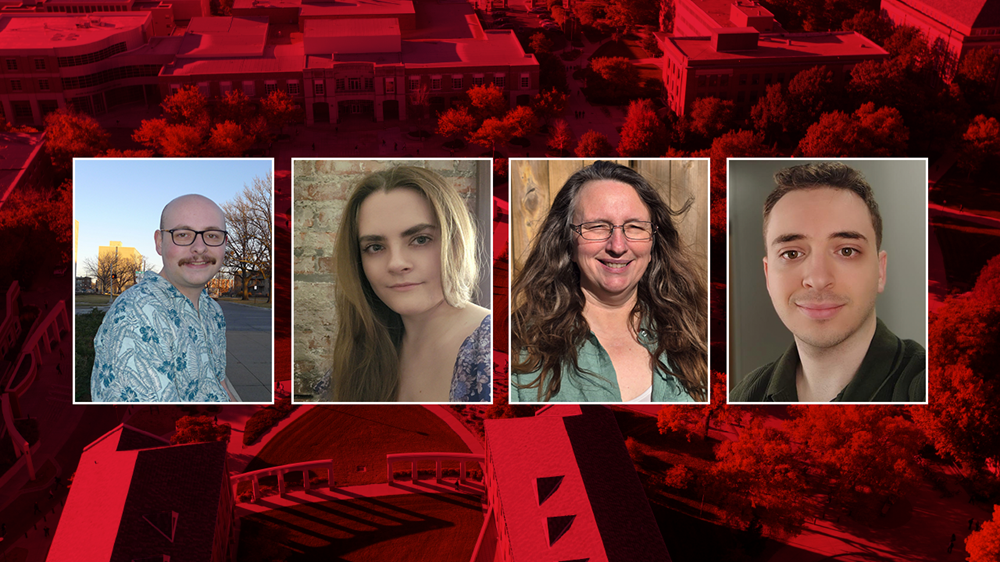
The following four scholars were chosen for the cohort:
Brianna Rose DeValk is a fourth-year doctoral student in history at Nebraska. She received a Bachelor of Arts in history pedagogy from California Lutheran University and a Master of Arts in history from Minnesota State University, Mankato. This summer, she will work on “Citizenship Taken: Recovering Married Women’s Citizenship on the Northern Great Plains, 1907-1967,” a relational database that brings together seemingly disparate historical records to reconstruct the identities and stories of American-born women whose birthright citizenship was taken following their marriage to an unnaturalized immigrant during the early 20th century.
Dana Hanley is a first-year master's student in modern languages at Nebraska. She holds a Bachelor of Arts in Germanic languages and literatures and a Bachelor of Science in education from the University of Kansas. Her Fellowship project, “‘Forever Undivided’: Mapping Connections Between the Failed 1848 Revolution in Schleswig-Holstein and Successful Civic Institutions in Nebraska,” utilizes ArcGIS StoryMaps to create a digital public history platform. Her work traces migration from Schleswig-Holstein following and documents the subsequent emergence of German-American civic institutions in Nebraska.
Henrique Cassol Leal is a doctoral candidate in philosophy at Nebraska. He received a Master of Arts in philosophy from the University of Missouri–St. Louis and a Bachelor of Arts in philosophy from the Federal University of Rio Grande do Sul (Brazil). His fellowship project, “The AI Moral Status Atlas: Mapping Concepts, Positions, and Argument Pathways in Contemporary Debate,” builds an “atlas” of key concepts, positions, arguments and objections in the debate about whether and how AI systems could have moral status.
Lexus Root is a second-year doctoral student in English at Nebraska. He also received a Bachelor of Arts in English from Nebraska. His fellowship project aims to develop a computational measure of sexual explicitness and violence in mid-20th century gay erotic fiction, relying on a corpus of thousands of 'gay pulp' novels.
The fellows will have opportunities during their shared time together to discuss their projects, brainstorm ideas and solutions, meet with practitioners, learn about University of Nebraska–Lincoln support services, and meet with libraries and Center for Digital Research in the Humanities faculty and staff.