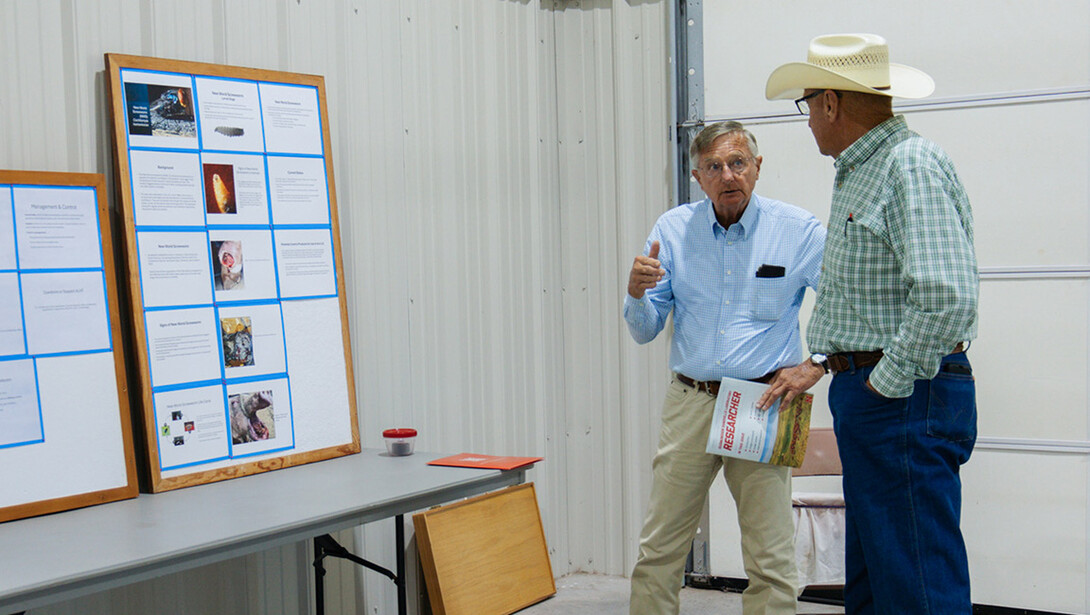
For 50 years, David Boxler's career with Nebraska Extension has been grounded in science, service and solutions for Nebraska cattle producers, providing effective practices to control pests around livestock.
Boxler, an Extension Educator and livestock entomologist, has his home base at the University of Nebraska–Lincoln West Central Research, Extension and Education Center, but his fingerprints can be found across the state and beyond.
Key breakthroughs in his career — such as establishing an economic injury level for stable flies in feedlots, identifying the impact of stable flies on pastured cattle, and testing a variety of methods to control pasture stable flies — have led to improved pest management and increased awareness among producers.
Boxler began his Extension career as a research technician under livestock entomologist Jack Campbell. At the time, Boxler held a bachelor’s degree in botany and had limited experience in entomology. With encouragement from Campbell, he soon pursued and completed a master’s degree in entomology, laying the foundation for his future work and transitioning into a research technologist role.
“The way I process things and deliver Extension programs to this day is based on Jack’s mentorship,” Boxler said.
Through his work with Campbell, Boxler began to see the value of Extension as a direct connection between university research and producers. He recognized a strong and ongoing need for research-based information in livestock pest management. This need continues as invasive species such as the New World screwworm and the Asian longhorned tick pose new threats to producers and resistance challenges increase.
With challenges like these on the horizon during his career, Boxler continuously worked directly with producers to understand their concerns and incorporate their ideas into his research.
An Extension-led workshop in Ainsworth focused on fly control led to testing a rancher’s idea: a patch designed to stick to an animal’s leg. His willingness to collaborate between research ideas and the experiences of those in the field is one main reasons his career has continued to remain relevant and applicable during the last five decades.
“You rely on producer insight because they are out there, and they are the ones making observations,” Boxler said.
As he continues to find effective ways to control flies on cattle, Boxler believes one of the most important breakthroughs of his career is discovering plant-based biopesticides because of their safety when applied to animals.
Over the past 20 years, Boxler has conducted significant research on plant-based biopesticides. These products are believed to be effective, provide a tool for dairy and organic producers, and have limited impact on many off-target species.
“It has been something very memorable to me to be involved essentially at the ground floor of this movement,” Boxler said.
Boxler hopes to see the final formulation of plant-based biopesticides evaluated and approved for marketing before he concludes his career.
With a legacy of unwavering commitment to Nebraska’s cattle producers, Boxler has helped transform the way producers approach controlling pests around their herds.
“Jack Campbell told me once, ‘Find a pest that you cannot control, and you will have a job for life,’ and that is where the stable fly comes in,” Boxler said.