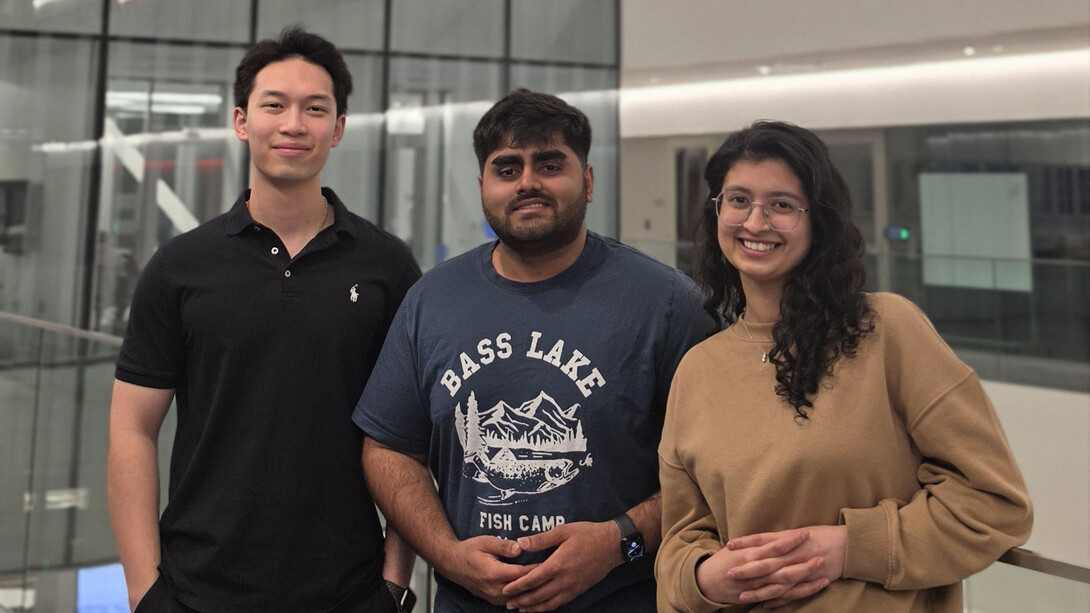
Vatsal Pandya came to the University of Nebraska–Lincoln at 18 as an international student from Mumbai, India, with plans to pursue big opportunities through his education. Through coursework, internships and personal drive, he has become CEO of his own company before graduating.
Pandya is the founder and CEO of TasksMind, a technology company using artificial intelligence to reduce on-call demand and fatigue among software engineers. Alongside School of Computing co-founders Kashish Syed and Thang Do, whom he met through international student networks and internships, Pandya aims to reshape workplace processes and culture in the tech industry.
“If you get paged at 2 a.m. because something went wrong and you already worked 9 to 5, you're not getting paid extra, but you carry that burden to work extra,” Pandya said. “No one wants to wake up at 2 a.m. and open a laptop. Engineers are human, so we want to keep the production systems alive, but let the engineers sleep.”
TasksMind is designed to handle the full lifecycle of an on-call incident. When it receives an alert, it investigates the issue, gathers context across repositories and logs, proposes a fix, tests it and opens a pull request. Unlike many AI tools, it is built to act within production systems rather than simply provide suggestions.
“If you ask ChatGPT to help you, it will give you a solution, but it wouldn't be accurate to your tech stack, your company or your code base, since it really differs from general knowledge to actual core knowledge,” Pandya said. “That's the biggest differentiator for us. We are not building another AI agent. Everybody's building AI agents, but ours has a specific niche for on-call work.”
Pandya said the idea for TasksMind came from his five internships, where he repeatedly saw the same problem: when production systems failed, one on-call engineer was often left responsible for late-night troubleshooting under pressure.
To validate the problem, Pandya conducted more than 100 interviews with engineers at Amazon Web Services and mid-sized technology companies. He found that on-call work typically followed a predictable sequence of steps, yet remained largely manual.
From there, he said, the solution became clear: build an AI system that could autonomously execute those steps.
“You're not implementing features at 2 a.m. You're making sure the systems are working or fixing whatever went wrong. It’s execution stuff,” Pandya said. “I thought, why not replace it with AI agents? They'll do all that for you and actually get it done.”
As he began developing the company, Pandya was selected for the Dedalus Labs Break In program, a three-week intensive residency in San Francisco that brings together founders, investors and mentors working on early-stage AI startups. He was one of 20 participants chosen from more than 450 applicants.
During the program, Pandya pitched TasksMind to more than 20 investors and secured backing from Forum Ventures and NVIDIA Inception. The company has since raised close to $500,000.
“It really boosted my confidence,” Pandya said. “We found our niche and what we need to work on, and I found my connections. So when I go back in May full time, I’ll already know people in the ecosystem and mentors who have been through the problems of a first-time founder.”
Pandya, a data science major, said Nebraska helped shape his approach to building the company. He pointed to professors who encouraged students to use artificial intelligence tools while still understanding the underlying work.
“The professors don’t say, ‘Don't use AI.’ They say, ‘Once you’re working, you’re not going to be typing line by line. You're going to use Cursor and Claude Code, so do your projects with those tools,’” Pandya said. “I really loved that encouragement to use AI products, but also learn not to fully rely on them, and make sure you actually know what you’re doing.”
Pandya will graduate in May and relocate to San Francisco to continue building TasksMind with his co-founders. While he said traditional job offers were an option, the team decided to fully commit to the startup.
“Going all in is the biggest thing required in a startup, because you cannot be working 9 to 5 and building a startup. It requires your full attention,” Pandya said. “I feel like the people working with me are all in and truly believe in the mission.”
In March, Pandya received an unexpected email from Apple, the company he once hoped to join. He had applied for an internship eight months earlier, before beginning work on TasksMind, and was invited to interview.
“If Apple had replied earlier, my life would probably look completely different, because I would’ve said yes immediately,” Pandya said. “At that point, I was still trying to get picked, but by the time they replied, I had already gone from applying for opportunities to building my own company. A delayed opportunity doesn’t always mean you missed out. Sometimes it means you were meant to build your own.”