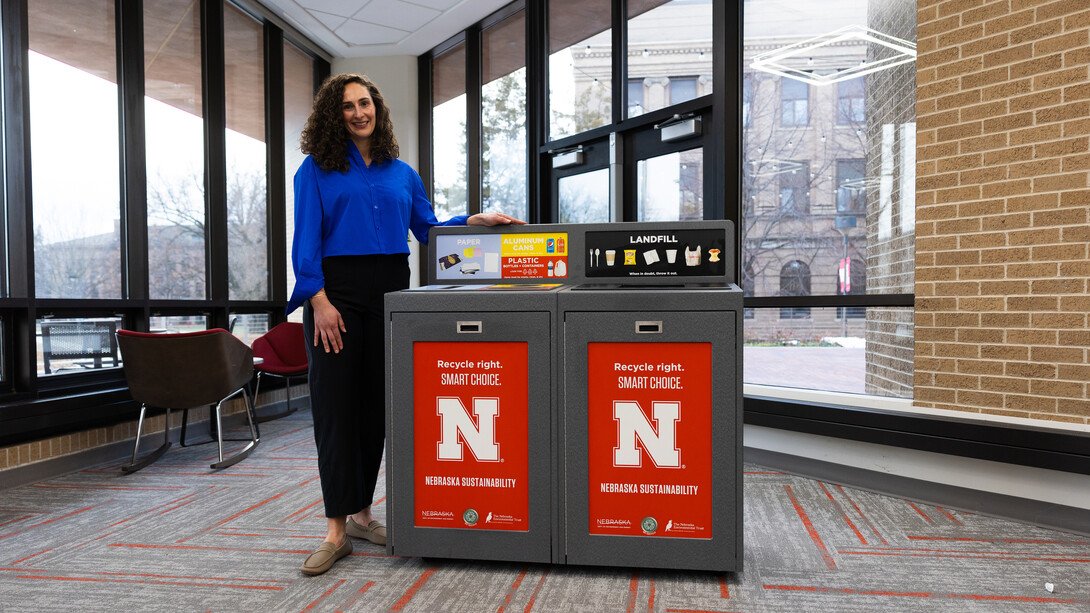
The purposefully designed recycling stations that dot nearly every building on campus are a visible reminder of the work Morgan Hartman does on a daily basis.
Hartman, sustainability manager, works to make the University of Nebraska–Lincoln more efficient and resilient and to educate campus community members about how they can make an impact. Hartman and her team in the Office of Sustainability design and implement initiatives, including the All in the Hall recycling program, guided by national benchmarking programs, like the Sustainability Tracking, Assessment and Rating system, and through campus community input via the office’s biennial Sustainability Culture, Literacy and Transportation survey.
This feedback guides efforts that will contribute to the long-term sustainability of the university.

“Sustainability is about being mindful,” she said. “Everything we use and dispose of has to go somewhere. It is important to recognize the impact that individual actions have on the university and broader community. We all have the opportunity to be responsible stewards of the resources entrusted to us.”
Hartman, who grew up in the Kansas City area, was drawn to Nebraska because of the natural resources and environmental economics major. As a student pursuing this degree, Hartman was able to develop a holistic understanding of sustainability, including the need to balance environmental concerns with economic feasibility.
During her undergraduate experience, she had the opportunity to put this learning into practice through leadership in the Association of Students at the University of Nebraska’s Environmental Sustainability Committee; her sorority, Chi Omega; and UNL’s Panhellenic Association.
“It was an opportunity to be an active part in what change making looks like on a college campus,” she said.
After graduation, Hartman worked in the nonprofit sector before returning to Nebraska to work for Lancaster County Extension in 4-H Youth Development focusing on recycling education.
In 2020, Hartman returned to campus as the university’s recycling coordinator, which has since expanded into the work she does now. In her role as recycling coordinator, she collaborated with internal and external partners to design what would eventually evolve into UNL’s All in the Hall recycling program.
The development of this initiative was driven by campus community feedback that indicated a need for a comprehensive recycling system across campus buildings to promote positive recycling at the university. Hartman worked with stakeholders across campus to build a program that would meet the needs of all campus community members, while also being feasible for campus operational partners, including Custodial Services, Refuse and Diversion Services and more.
“We needed to build a program that made sense for everyone — the building occupants, the custodians, our Refuse and Diversion Services team members — while also being feasible for the university.”
This included applying for grant awards from state agencies including the Nebraska Department of Environment and Energy and the Nebraska Environmental Trust, engaging with university leadership and working with building occupants to understand specific traffic patterns to determine recycling container locations that would make it easy for students, faculty and staff to recycle.
“All in the Hall is near and dear to my heart,” Hartman said. “Providing comprehensive and consistent waste infrastructure in our campus buildings is something that is very tangible and important. It has been incredibly meaningful to develop this initiative from an idea to what is now our campus standard.”
Hartman is proud of the growth of the sustainability team and program since she started at Nebraska, which has been made possible through broad support and effort from many individuals and departments across campus. Hartman was able to see this effort first hand when she coordinated the university’s 2022 STARS submission, which led to UNL’s inaugural gold rating from the program. The Sustainability Tracking, Assessment, and Rating System helps colleges and universities across the world measure their performance in areas like academics, engagement, operations and innovation. Hartman and her team are in the final stages of compiling the university’s next submission, which they expect will again yield positive results and spur continued progress on campus.
Hartman, along with Madeline Yeatts, sustainability coordinator, was also proud to represent Nebraska as a participant in the pilot cohort of the Carnegie Elective Classification for Sustainability. The university is one of 21 schools across the United States, and the only Big Ten institution, engaged in developing this new tool that will help institutions measure their sustainability performance, drive progress and showcase their commitment to sustainability.
“I’m really proud that we were selected to engage in the Carnegie pilot,” Hartman said. “We know that sustainability is a priority for our students, and it’s important for us to keep our thumb on the pulse of what’s new and next in the industry to allow us to continue to position UNL as a leader.”
This year, Hartman’s work has come full circle through the university’s academic mission, as she serves as the instructor for the Environmental Engagement and the Community course in the Environmental and Sustainability Studies department. In this experiential learning course, Hartman connects with campus partners to educate students about the university’s broad efforts to be more sustainable. Students then identify areas of opportunity for enhancement and work in teams to develop solutions. In the past two semesters, students have worked on a number of projects to increase sustainability for the university — ranging from waste diversion to energy efficiency to transportation.
Students in the spring 2025 class studied Dining Services’ reusable container program and recommended expanding drop-off locations to make returns easier and reduce single-use waste. This work prompted Dining Services to expand the program to additional dining centers and add more collection points for reusable containers across campus this fall.
“I really enjoy the opportunity to work in the classroom with our incredibly talented UNL students to help them realize their potential and act on it,” Hartman said. “Through this course, students build their capacity for problem solving, teamwork, initiative and many other transferable skills that will be important for them in their future careers.”
For Hartman, her work is rooted in connecting with others to recognize and implement opportunities for impact. Whether through informal recycling-focused outreach at campus events, leading conversations with campus stakeholders or facilitating student learning in the classroom, Hartman is passionate about educating those around her about the importance of responsibly stewarding resources. By encouraging people to take action in their daily life and pointing them to the resources to contribute however they can, Hartman hopes the effort leads to a better community for everyone in it.
“Individual action can lead to a strong collective impact,” Hartman said.