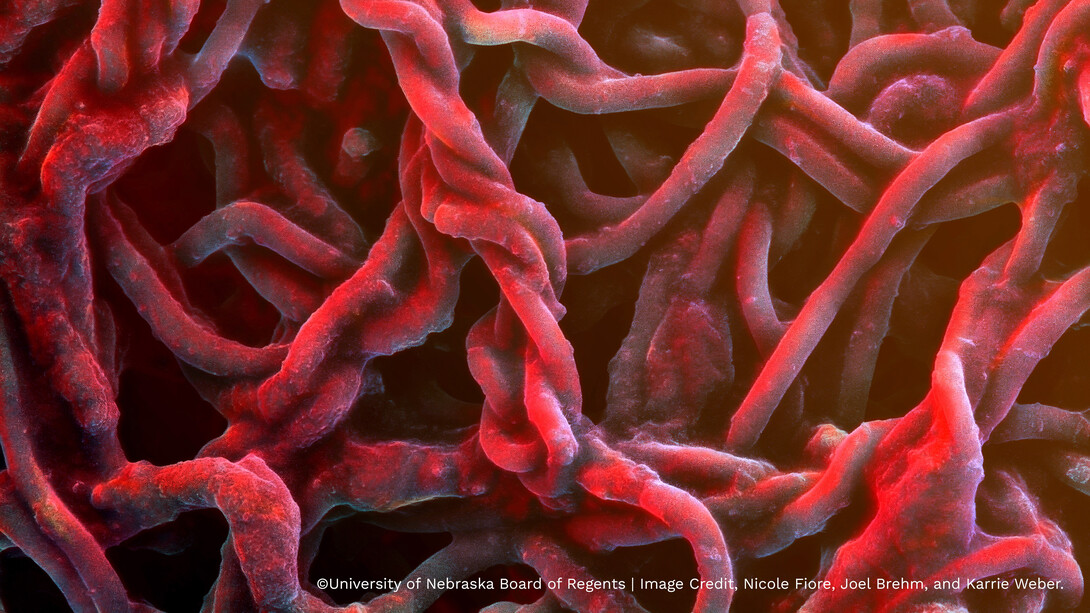
To the untrained eye, the cells of a newly discovered microorganism look larger than they are.
That size is an illusion created by a unique growth trajectory: When cultured on rich medium, the individual cells twist around each other, and then those structures twist again, forming thick, rope-like structures that microbiologists call aggregates — a formation that enhances survival and buffers against environmental stress.
It is a microscopic strategy that reflects a way of life in Nebraska: strength through connection.
It is fitting, then, that a University of Nebraska–Lincoln research team has named the novel microbe — a methanogen collected from a salty, higher-pH wetland in Lincoln — after the Cornhusker State. Methanobacterium nebraskense is the first organism in the domain Archaea to be named after Nebraska.
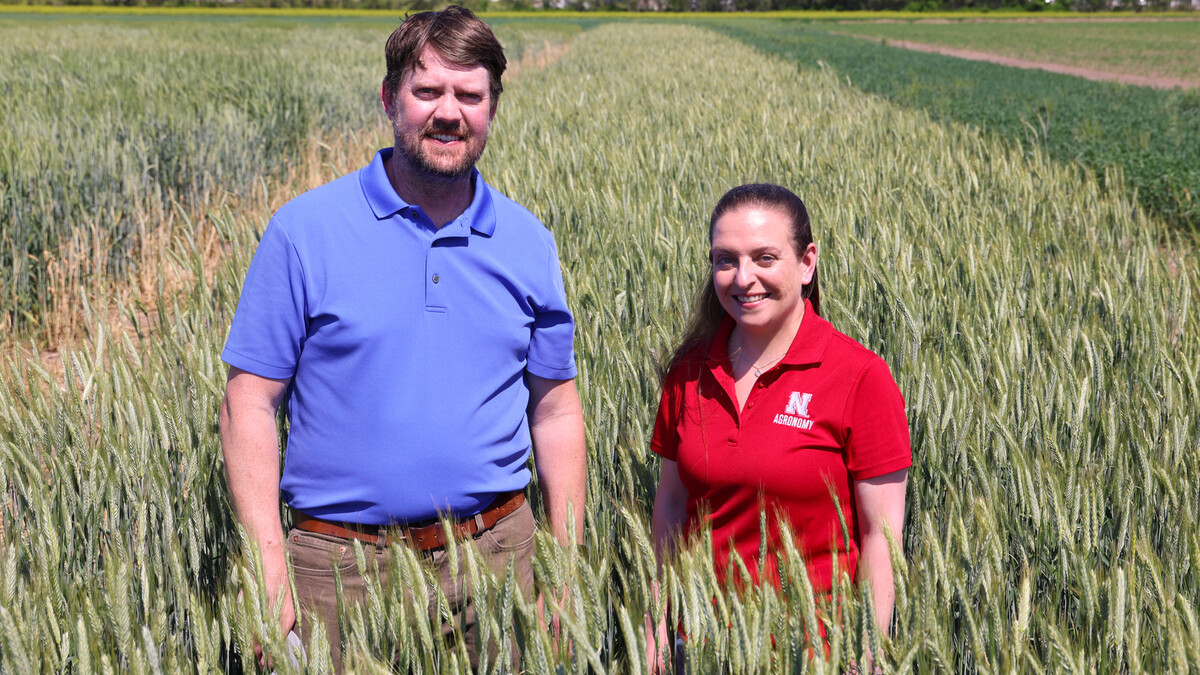
A publication in the International Journal of Systematic and Evolutionary Microbiology announced the new name, culminating a more than five-year endeavor of Karrie Weber and Nicole Fiore to isolate, culture and demonstrate the methanogen’s novelty.
“Microorganisms often are named after locations in which they were isolated from, but there were a lot of Nebraska ties here, so it seemed like an especially fitting and appropriate name,” said Weber, professor of biological sciences and Earth and atmospheric sciences. “The cells themselves had a cool phenotype. We also had a lot of support from the Nebraska Center for Biotechnology, the Nebraska Center for Energy Sciences, the Holland Computing Center and other resources on campus.”
M. nebraskense is also the first published archaeal microbe isolated from the Eastern Saline Wetlands, a nationally unique and endangered ecosystem located in and around Lincoln created by the upwelling of saline groundwater.
“Naming the species after Nebraska was important not only to represent the state, but also its natural resources,” said Fiore, a former Husker graduate student in Weber’s lab who is now a postdoctoral researcher at Dartmouth College. “The saline wetlands are a really unique but vulnerable environment, and many people aren’t aware of them.”
Isolating new and novel microorganisms is no easy feat, underscored by the fact that scientists have cultured only 1-2% of microbial life on the planet. There are myriad reasons the remaining “microbial dark matter” remains a mystery: reliance on symbiotic relationships, metabolic codependence, unknown or highly specific nutritional requirements and challenges replicating organisms’ native habitats are just a few of the obstacles.
In the case of M. nebraskense, Weber and Fiore’s strategy focused on analyzing genomic data to pinpoint the microbes’ unique metabolic pathways, then using that information to design culture conditions to promote growth. They also had to eliminate cohabiting microorganisms.
“We came up with an antibiotic cocktail that would kill the bacteria they were living in close association with,” Weber said.
The duo successfully cultured the methanogen, with the original intent of studying whether, when alone, it was able to dissolve calcium carbonate as part of or as a consequence of its metabolism — a question that was part of a landmark study published in 2025. But once they realized it was a novel organism, they proceeded with naming it, following a process governed by the International Code of Nomenclature of Prokaryotes.
Fiore and Weber characterized the methanogen, demonstrating its novelty in terms of shape, structure, physiology, metabolism and genetics. They also distinguished it from close relatives and deposited it in two culture collections — the American Type Culture Collection and the Leibniz Institute DSMZ-German Collection of Microorganisms and Cell Cultures GmbH.
Following the publication, M. nebraskense will appear on the International Journal of Systematic and Evolutionary Microbiology’s validation list and become part of the official nomenclature.
Though naming the novel methanogen is exciting for Weber, she remains focused on the big-picture questions that drive her research program at Nebraska. To her, isolating organisms and exploring their characteristics is part of the larger goal of understanding complex community dynamics in the soils and subsurface. She is particularly focused on understanding how microbes use carbonates and hydrogen — knowledge critical to developing sustainable bioenergy and geological energy sources, as well as other biotechnology applications.
“I don’t think we fully know all the many ways that microorganisms can live and survive,” she said. “I think we’ll continue to discover new ways that organisms survive in the environment. And we’re trying to do that by not only understanding what’s going on in the community, but by trying to take organisms apart.”
The work was supported by a NASA Nebraska Space Grant and funding from the Nebraska Center for Energy Sciences Research and the National Science Foundation.