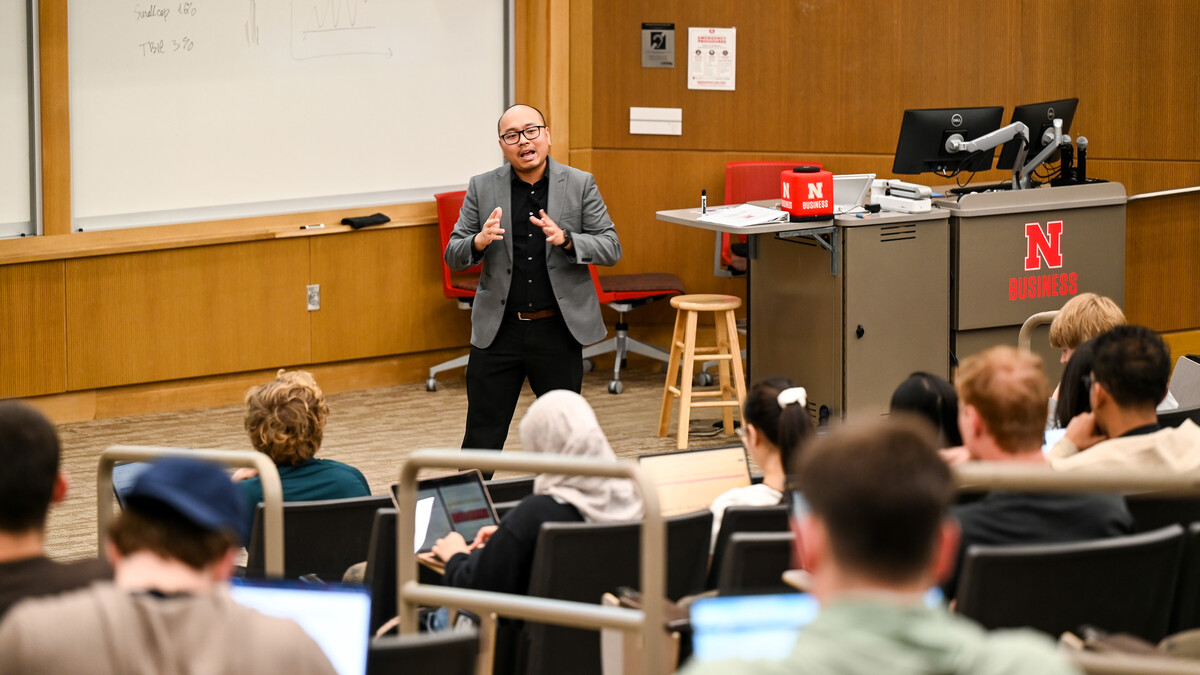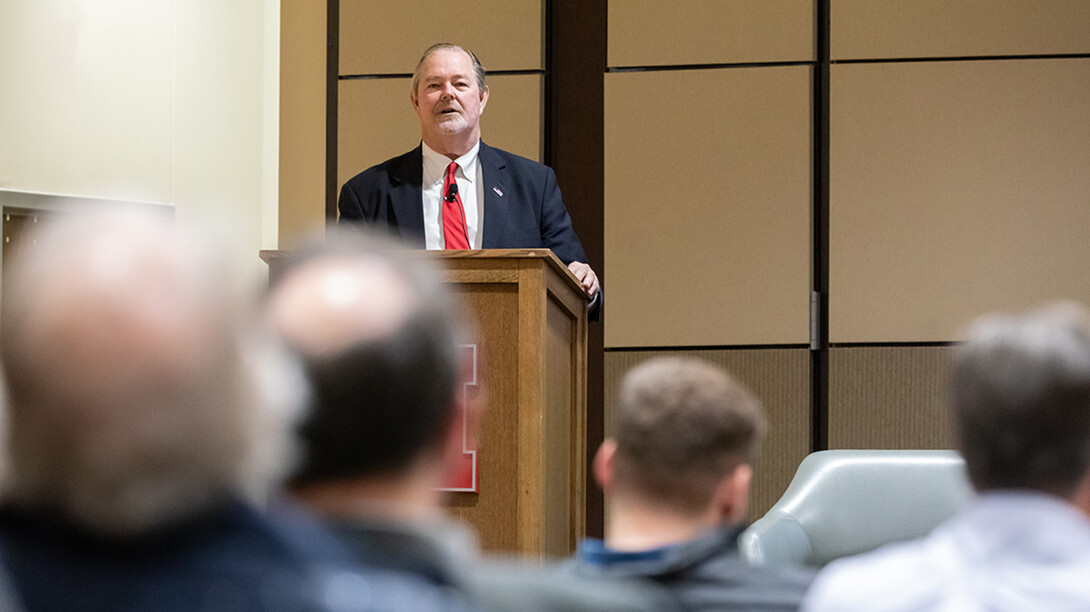
Technological innovation will bring important new benefits to agriculture, and the nation’s land-grant universities are central to advancing that progress, the U.S. Department of Agriculture’s chief scientist said in an April 28 Heuermann Lecture.
Scott Hutchins, the USDA’s under secretary for research, education and economics, said land-grants such as the University of Nebraska–Lincoln play a “pivotal role” in ag-focused research, producer impact and training of students as the next generation of scientists.
“The sustainability and continuance of what land-grants provide to agriculture has been unbelievable, and it has been the reason we have been successful,” Hutchins said in a Heuermann Lecture discussion in the Nebraska East Union moderated by Tiffany Heng-Moss, the Harlan Vice Chancellor for the Institute of Agriculture and Natural Resources.
Hutchins directs operations and strategic management for a set of major USDA components including the Agricultural Research Service, which has longstanding research partnerships with IANR. As part of the USDA’s current reorganization, he said, the department is moving eight ARS positions to the federal Hruska Meat Animal Research Center in Clay Center.
Agricultural Research Service is also moving two positions to East Campus, bolstering its longstanding research presence there in partnership with the university.
“It doesn’t matter who gets the credit or even who does the work as long as we’re solving the problems that U.S. agriculture faces,” Hutchins, who has a doctorate in entomology, said in describing ongoing Nebraska research collaboration with Agricultural Research Service.
Nebraska stands out not only for its research innovation but also for its Extension outreach to producers and stakeholders, amplifying the university’s importance for the state’s ag sector, he said.
Hutchins noted the importance of food and ag production security and the threats he’s learned about in that regard through his top secret security clearance. The University of Nebraska System contributes to food security through its National Strategic Research Institute, one of 15 federally designated University Affiliated Research Centers partnering with the Pentagon.
Hutchins, an adjunct with the university’s Department of Entomology, shared a graphic showing the steep increase in U.S. agricultural productivity since the end of World War II.
Achieving further productivity gains and sustainability progress is vital for agriculture, and digital and precision ag technologies, including artificial intelligence, are key tools in that effort, he said.
“Part of that progress will be driven by the impact of AI to sort through germplasm and sequencing and catalogs,” Hutchins said in regard to plant science innovation. “When it comes to breeding and the genome design, it’s all about speed.”
As part of that effort, USDA is building a $160 million facility on Nebraska Innovation Campus. The ARS National Center for Resilient and Regenerative Precision Agriculture will be the only federal center in the United States focused on sustainable, digital and precision agriculture. The university will build an adjacent business accelerator to commercialize the resulting research into new ag- and natural resources-focused innovations for producers and industry.
USDA also is honing plans for the Agriculture Advanced Research and Development Authority, modeled after the Department of Defense’s landmark DARPA initiative crucial in developing the internet and GPS.
Hutchins spoke in detail about the need to pursue technological innovations to achieve “the next generation of weed management.” Innovations in insect control similarly are enabling increasingly precise insecticide applications.
“I'm excited about that potential and about the fact that we can move at the speed of innovation, not at the speed of regulation,” Hutchins said.
NFarms, a 3,500-acre IANR agricultural technology innovation hub near Mead, is an example of such strategic research focus. The multi-disciplinary precision ag initiative includes drone- and sensor-enabled operations to lift productivity and resilience; software solutions to provide cloud-based ag data storage and data analytics; and innovations to further boost nitrogen management and ag robotic efficiencies.
Hutchins described the structure and priorities of the research, education and economics mission area he heads for USDA. One priority is “strengthening the domestic pipeline of advanced degree students in agricultural sciences and economics.”
Land-grant universities serve a key role by nurturing the upcoming generation of ag-focused scientists, he said. Strengthening such intellectual capital is a key need to ensure needed technological innovation and resilience for agriculture.
USDA Secretary Brooke Rollins agrees 90% with the Make America Health Again agenda pursued by Robert F. Kennedy Jr., head of the Department of Health and Human Services, Hutchins said. On the remaining 10% of MAHA issues, Rollins is stalwart in defending ag sector interests, he said.
IANR’s Heuermann Lecture series focuses on providing sustainability in the areas of food, natural resources and renewable energy for people as well as securing the sustainability of rural communities where the vital work of producing food and renewable energy occurs.
The series is made possible through a gift from B. Keith and Norma Heuermann of Phillips, Nebraska, as an enduring commitment to Nebraska's production agriculture, natural resources, rural areas and people.