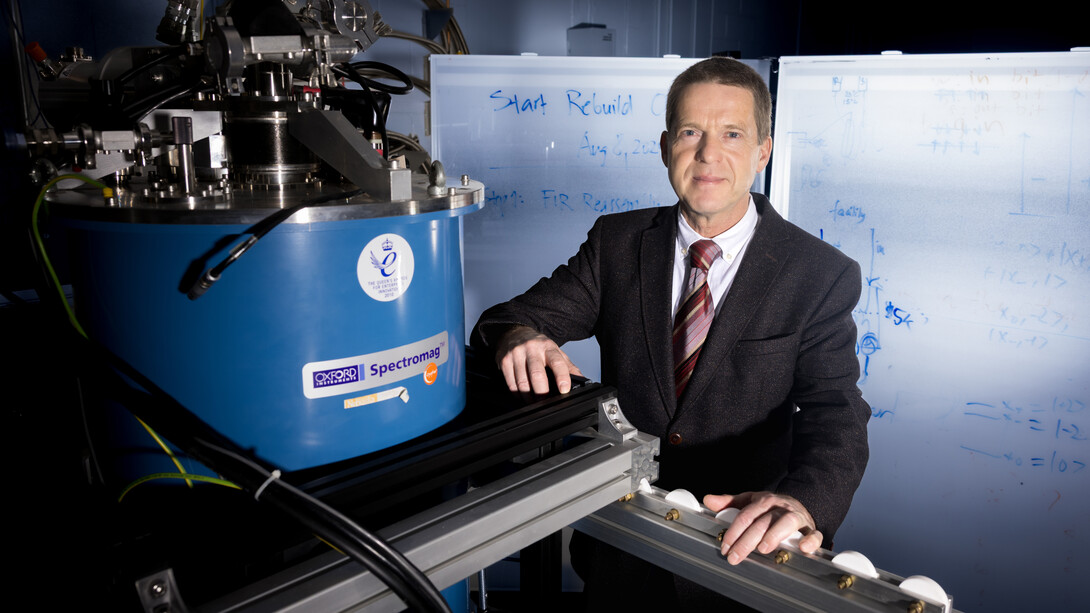
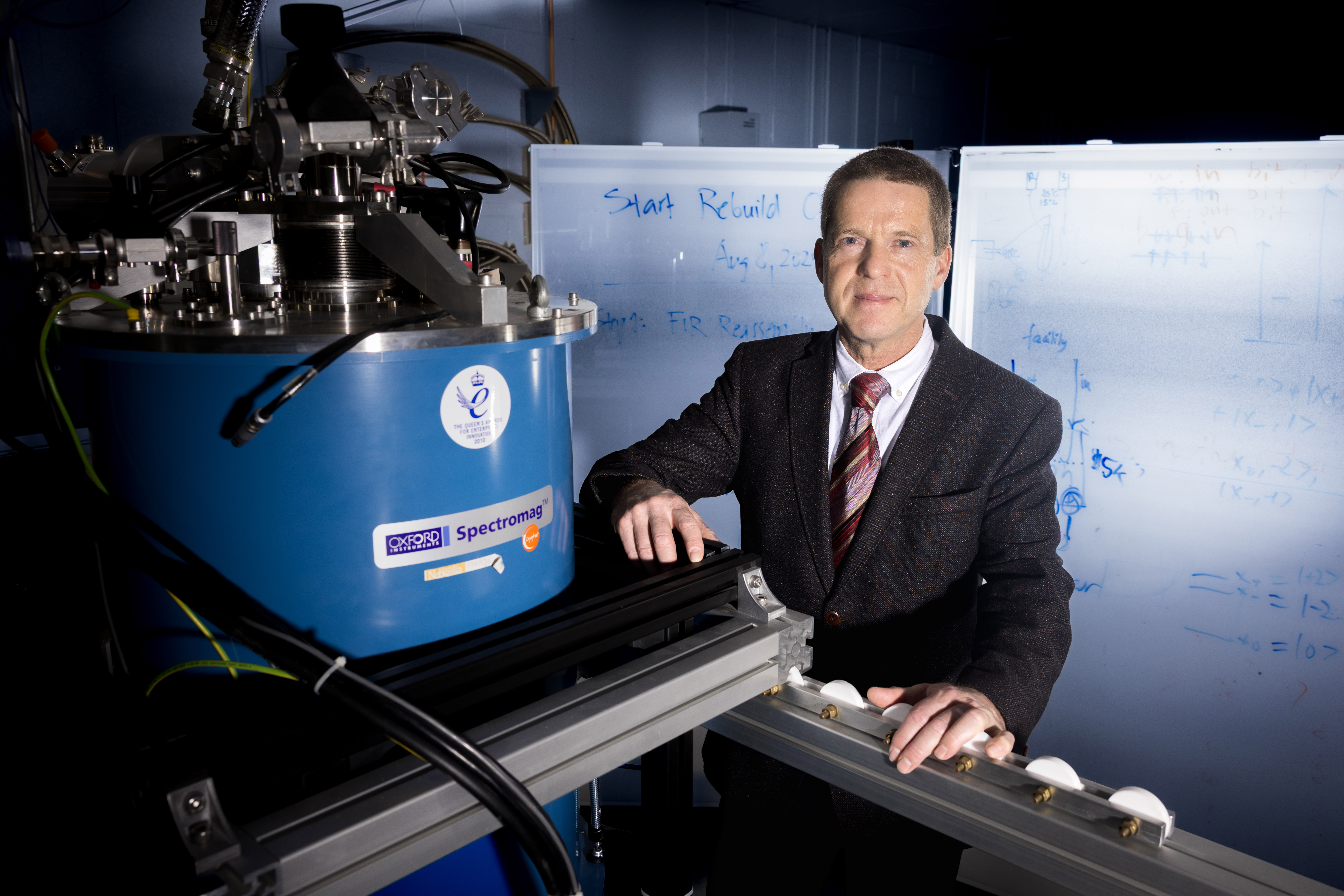
Mathias Schubert, one of the world’s foremost innovators in the field of optical ellipsometry, has been elected to the 2025 class of National Academy of Inventors Fellows, the highest honor the organization bestows.
Schubert joins 13 University of Nebraska–Lincoln faculty as National Academy of Inventors Fellows. The honor recognizes researchers whose work has been translated into inventions and technologies with societal impact.
Schubert, J.A. Woollam Distinguished Professor of Engineering, has spent 20 years at Nebraska pursuing the greatest challenges that come his way — from ellipsometry to myriad international collaborations.
Though his university faculty webpage lists nine patents and 11 papers that bear his name, Schubert said there have perhaps been hundreds more of each in his lifelong journey from student to toolmaking, to physics, to engineering and to research pioneer.
The idea of being a prolific inventor, Schubert said, is something he has not paid much attention to since joining the Department of Electrical and Computer Engineering in 2005.
“To tell you the truth, I have no idea how many patents or papers there are with my name on them. I’m not focusing on that,” Schubert said. “Other people say I should write a patent or a paper for so many things. I tell them I’d rather try this or I want to try that because new things keep popping up on my radar and pursuing those things is what makes my work so exciting.”
Schubert’s research focuses on broad spectral range optical characterization materials, both organic and inorganic, and uses ellipsometry, a material-probing technique, to explore ways to increase and harness the electrical capabilities of materials. These innovations lay the foundation for breakthroughs in myriad fields, such as development of more efficient semiconductors, optics and displays for quality control of manufacturing systems, process monitoring and materials research.
His work has led to numerous advancements in the field of optical ellipsometry and multiple inventions, including the optical Hall effect in semiconductors, interface polarization coupling, form-induced optical anisotropy in nanostructure material and ellipsometric instrumentation development.
Currently, Schubert’s work uses ellipsometers and quartz crystal microbalances simultaneously to measure thin film evolution and Terahertz ellipsometers to detect charge carrier channels and spin resonances in electronic devices.
A more recent project is one Schubert said he is especially excited about — an international collection of esteemed researchers working to identify new semiconductor materials for high-power applications. These include ultra-light band gap semiconductors that could ease growing demands on power grids driven by artificial intelligence and data centers.
The team is searching for its “holy grail,” Schubert said — a way to integrate ceramics into semiconductors, allowing for greater control of heat and resistance at higher voltages.
“A semiconductor changes its conductivity to the better when you heat it up, while metal changes it to the worse when it gets warm,” Schubert said. “That’s why we have to find elements and materials that can make this control possible.”
It has led the researchers to focus on gallium oxide, an inorganic material that has exhibited wide-bandgap semiconductor properties that make it a good choice for the manufacturing of high-voltage switches and power devices.
Because supplies of high-quality gallium oxide crystals aren’t readily found in nature, Schubert said, it requires scientists to adopt an approach that mimics the farm-to-table processes of high-end restaurants to create wafers of thin films of the semiconductor material.
James Speck at the University of California, Santa Barbara, starts the process by “growing” crystals from precursors and raw materials dug from deep underground.
He then works with Debdeep Jena from Cornell University and Zbigniew Galazka from the Leibniz Institute for Crystal Growth in Germany to make wafers of the ultrathin film, which are sent to Schubert, whose Nebraska research team assesses their quality and performance before making them available to potential consumers.
“It’s following a recipe, and we each have to approach this from a different perspective and with a different expertise,” Schubert said. “Each of us thinks about, ‘How can I optimize the bowl in which I’m cooking?’
“What I find, they’re super interested about: ‘Does it change the properties?’ ‘If you incorporate this other element, could we push a little over there so there’s a constant exchange?’”
The 2025 fellows include 169 researchers from across the United States, who combined hold more than 5,300 U.S. patents and include Nobel Prize recipients.
While the current project is a noble quest, Schubert is most excited about the discoveries still ahead — even if he doesn’t have them mapped out
“I actually, honestly, have the opinion that if what I do is of interest, the problems will find me,” Schubert said.
“There’s this concept of doing things at different frequencies, different mathematical approaches, that’s what you see all over the place. So many brilliant minds out there, and everyone’s going to have ideas. That’s exciting, to work with those people together, just listening to them and learning.”
Share
News Release Contact(s)
Related Links
Tags
High Resolution Photos
HIGH RESOLUTION PHOTOS