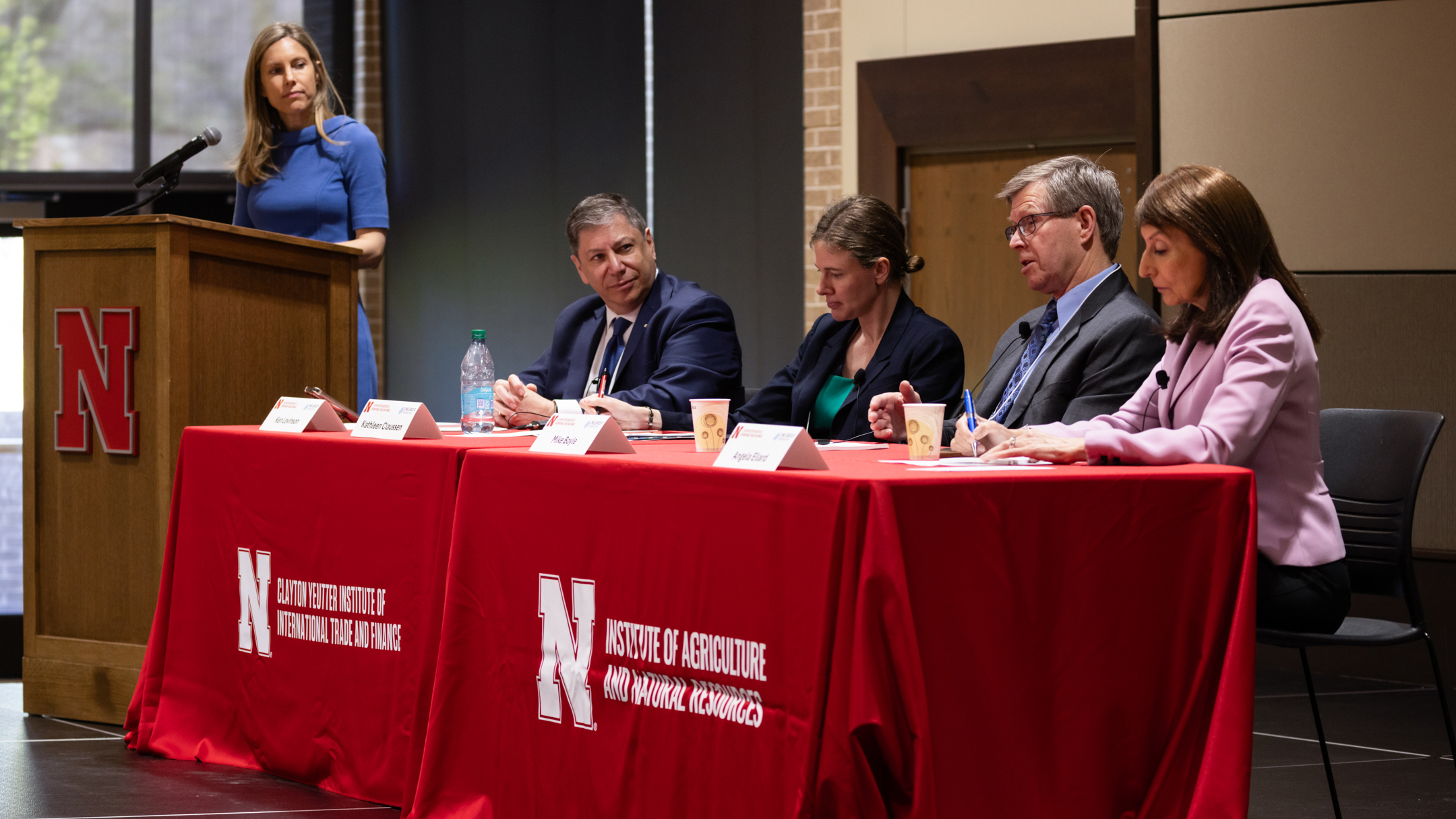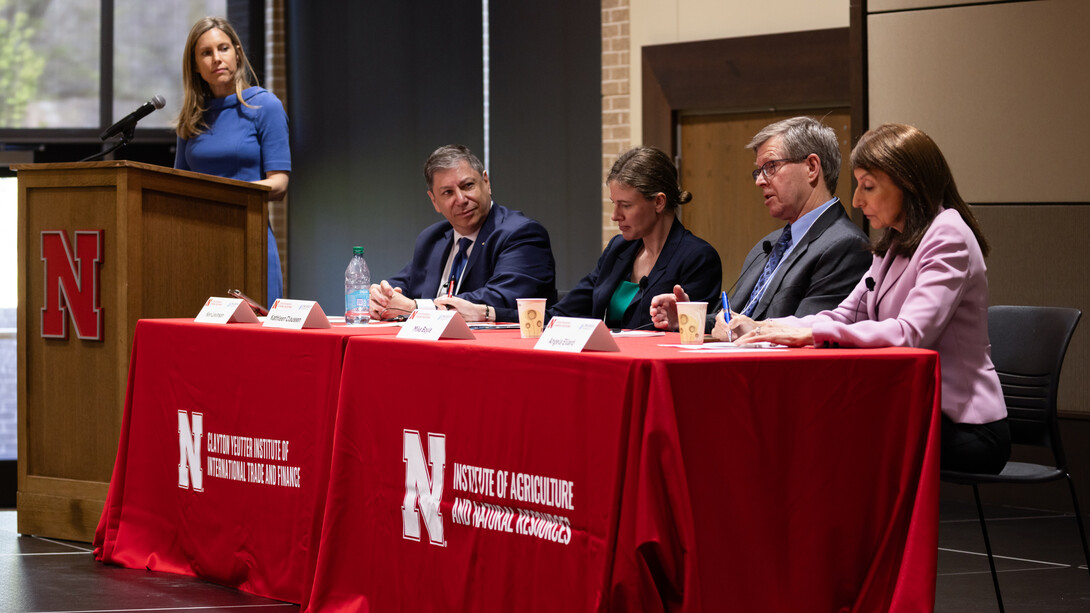
The Trump administration is using effective leverage to gain significant concessions from trade partners, with results including a marked reduction in the agricultural trade deficit, a top U.S. trade negotiator said in an April 21 Yeutter Institute symposium at the University of Nebraska–Lincoln.
Other speakers pointed to complications on the trade front, including uncertainties about the administration’s trade deals and the negative effects U.S. tariffs have on some Nebraska businesses, such as the Kawasaki plant in Lincoln.
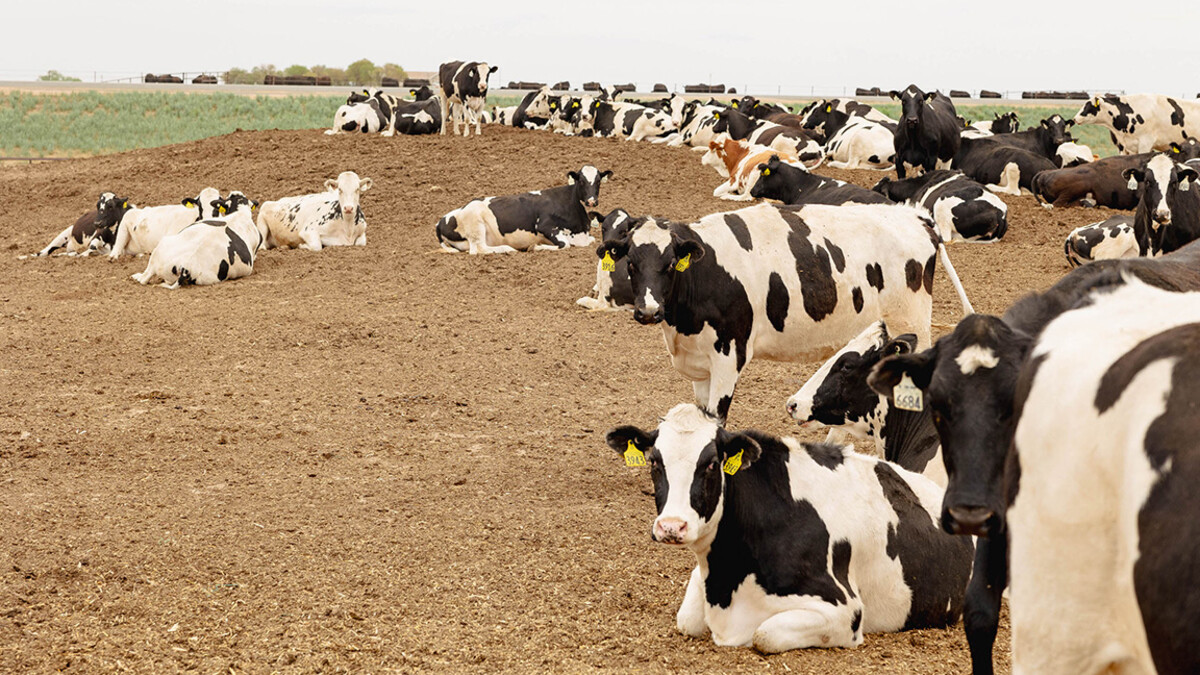
The discussions highlighted that while global trade remains important to Nebraska’s agricultural sector for the long term, domestic demand will likely be a growing factor affecting U.S. agriculture through value-added products such as biofuels plus increased demand for animal feed.
The university’s Clayton Yeutter Institute of International Trade and Finance hosted the symposium at the Nebraska East Union, with support from the CME Group Foundation. The event focused on the theme “Toward a New International Trading System” and was led by Jill O’Donnell, the Yeutter Institute’s Haggart-Work Director.
Julie Callahan, chief agricultural negotiator for the Office of the U.S. Trade Representative, said the Trump administration’s reciprocal tariffs provided leverage that, “helped us to negotiate very meaningful commitments from trade partners to remove the unjustified trade barriers and provide market access concessions.”
Over the past year, the U.S. has achieved nine agreements on reciprocal trade plus nine framework deals now being finalized.
“The progress we have been able to make this year has been revolutionary in addressing some of our longstanding challenges with trade partners,” said Callahan, who has held senior agriculture-focused positions at the Office of the U.S. Trade Representative for the past nine years.
When President Donald Trump took office in January 2025, the U.S. had a monthly ag-trade deficit of $6.5 billion. In January of this year, the deficit was down to $1.75 billion, she said.
While the administration has had to shift its reliance onto certain tariff approaches in the wake of a recent Supreme Court ruling, “our trade policy remains consistent,” she said. “The new trading system that we’re envisioning will be a restoration of fairness and balance to U.S. trading relationships.”
Joe Glauber, former chief economist for the U.S. Department of Agriculture, said the size of the ag trade deficit stems less from tariff changes than from broader factors such as the level of U.S. import demand for seasonal fruits and vegetables and inputs such as feeder pigs plus low prices for U.S. export commodities such as corn and soybeans.
Mike Boyle, president of Kawasaki Motors Mfg. Corp., U.S.A., described how U.S. tariffs have raised input costs and caused supply chain complications for many U.S. manufacturing companies and foreign-owned facilities such as Kawasaki’s Lincoln plant, the largest manufacturing site in Nebraska. The plant employs 3,000 people making off-road vehicles, railcars, subway cars and large parts for Boeing aircraft.
“About 80% of the manufacturers I’ve spoken with or worked with feel some negative impact,” Boyle said, referring to discussions among U.S. business leaders in various manufacturing associations.
Implementation of the Trump administration’s “Liberation Day” tariffs announced in April 2025 automatically wiped away major cost advantages for Kawasaki’s Lincoln plant, said Boyle, a Lincoln resident who holds a bachelor’s degree in mechanical engineering from the University of Nebraska–Lincoln.
Once Kawasaki calculated the tariffs’ full impact, Boyle said he found it “the largest threat to my business in my 40 years of business.”
Angela Ellard, a panelist who served for more than two decades as majority and minority chief trade counsel in the U.S. Congress, urged the business community to make its views known to members of Congress. Nebraska businesses, she said, have a “good ally” in Rep. Adrian Smith, who represents Nebraska’s 3rd District and chairs the House Ways and Means Subcommittee on Trade.
Many panelists noted lingering uncertainties involving the trade deals’ specifics, implementation and durability. It’s important to “solidify” the specifics to provide ag producers with long-term assurance, said Jordan Dux, senior director of national affairs for the Nebraska Farm Bureau Federation.
Dux was among many panelists who spoke about U.S. agriculture’s connections to the global marketplace. Steve White, farm director of radio channel KRVN, moderated an ag-focused discussion panel and noted that over the past year, 300 of KRVN’s newscasts focused on trade.
Jayson Beckman, the Mike Yanney Yeutter Institute Chair in the Department of Agricultural Economics, said he categorizes the current trade deals into “the good, the bad and the not likely to happen.” Recent deals with Indonesia and Taiwan offer significant market openings to U.S. exports, while deals with Bangladesh and Cambodia are not likely to amount to much, said Beckman, who previously worked as a senior economist with the U.S. Department of Agriculture’s Economic Research Service.
U.S. exporters could be particularly helped if more can be done to address non-tariff barriers such as idiosyncratic regulatory and licensing requirements other countries use as de facto protectionist measures, Beckman and Dux said.
Some Southeast Asian countries offer increasing export opportunities for Nebraska meat exports, Beckman said, as the increase in middle-class incomes generates greater demand for beef, pork and chicken.
At the same time that overseas markets remain important for Nebraska agriculture, “there’s a large conversation happening on domestic demand,” Dux said. That conversation includes promising long-term prospects for sustainable aviation fuel and maritime fuel, expanded ethanol sales and increased demand for animal feed.